


Though I don’t do a lot of food posts anymore, some of our long-time readers may remember a time when I was pretty involved in that niche of the blogging world. I was on a couple Ambassador panels, and whenever I’d go to a meet up with other food bloggers, it was inevitable that someone would bring up knives. I totally admit how nerdy that is, but it’s just what happens when it’s such a big part of what you do every day. And there are some really strong opinions about kitchen knives out there, let me tell you. And a lot of those strong opinions are at odds with one another.
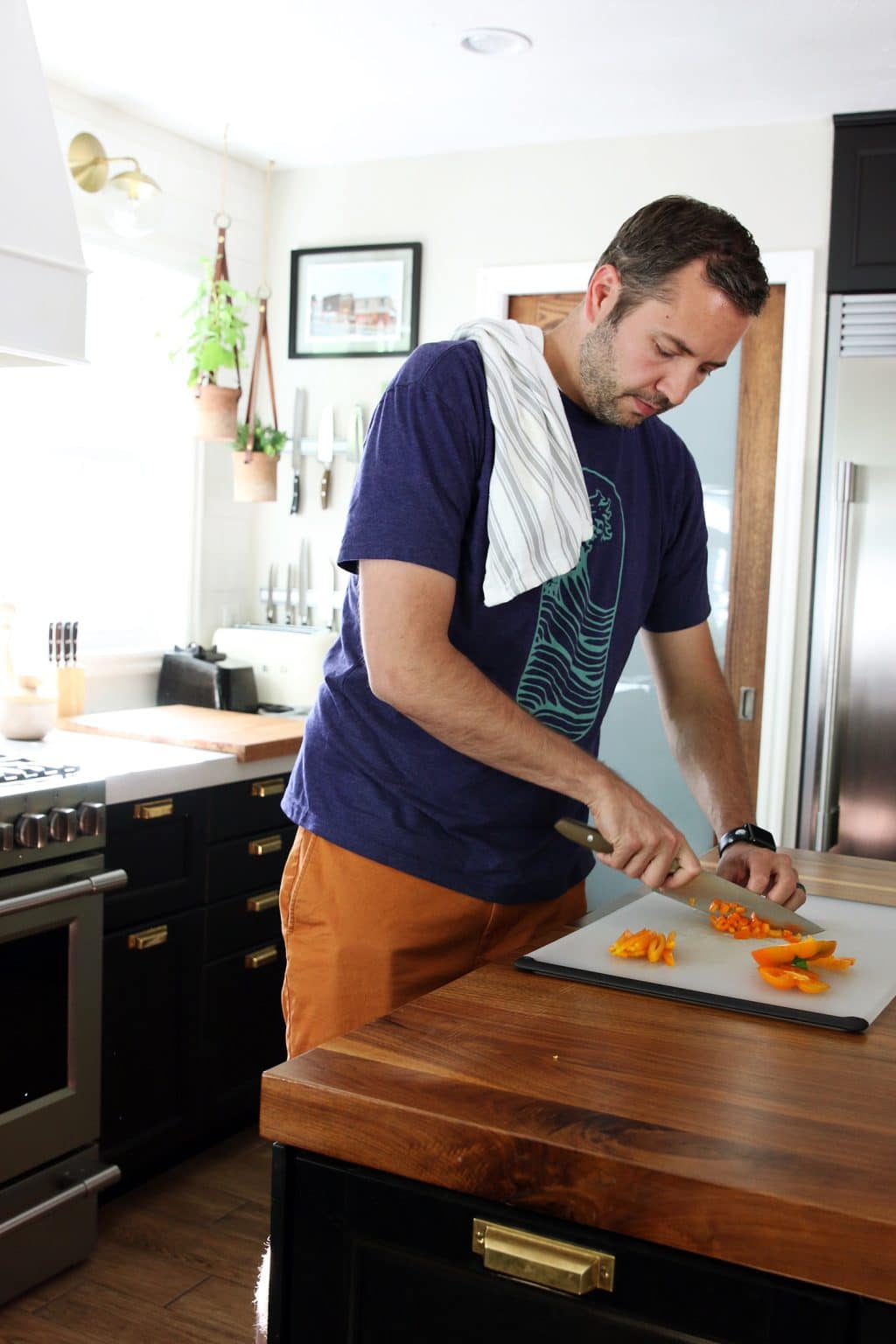
We’ve had a lot (like, surprisingly a lot) of you who have asked for details on choosing the right knife set and taking care of it when you’re just starting out, or when you’re wanting to get more serious about cooking, or when you’re ready to fully embrace your food nerd-dome. And while I’m more than happy to share my thoughts on all of this, one thing I won’t harp on is knife brand.
Don’t get me wrong, I have my favorite brand. This entire post is probably going to feel like a Wusthof commercial (even though they are not sponsoring this post) because that’s all I use now. But I’ve reached that point after using a variety of knives and determining Wusthof is what I prefer.
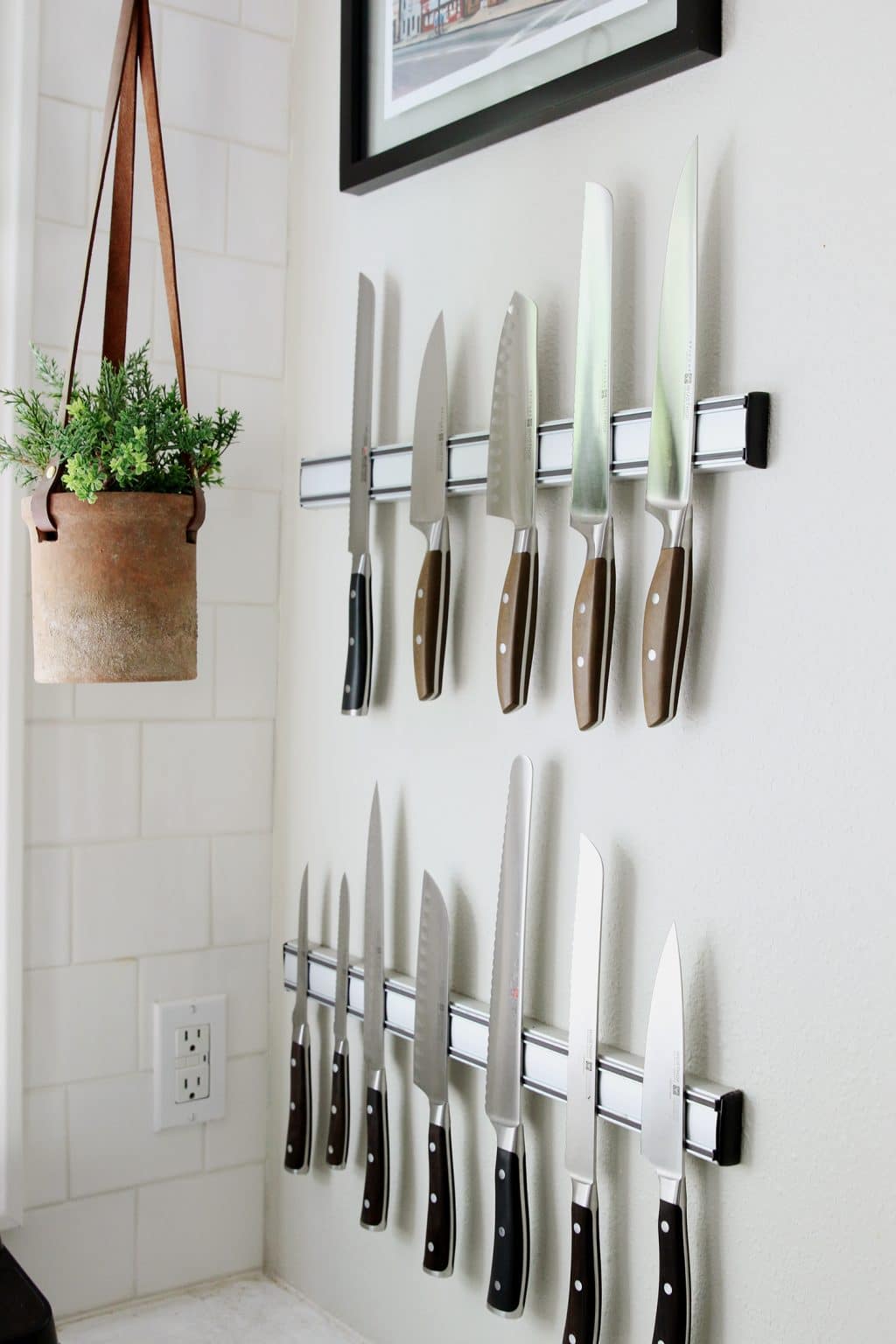
Through this post I’ll share things to consider for yourself when purchasing knives, link to some options at different price points, and list a few brands worth looking into. And hopefully, at the end, you’ll be a little closer to getting the knife that’s perfect for where you are in your culinary journey.
German VS. Japanese Steel
This is a big debate, and there are lots of little details people get hung up on with this. But for the average home cook, straight up, it doesn’t matter one ounce which one you go with. The basic idea is that Japanese steel is harder, so keeps an edge longer. It’s also more prone to chipping if you’re cutting through bones or stuff like that and should be professionally sharpened. German steel is softer, so it gets dull quicker. But it’s also less brittle and can be kept sharp by a novice knife owner with a little know how.
But when I say this, the tendency is for people to picture knives made of glass (Japanese steel) or salt water taffy (German steel). When in actuality the difference is minimal. German steel keeps an edge really well, and it takes some abuse for Japanese steel to chip. I suggest paying less attention to the type of steel, and more attention to the shape of the blade and handle, as well as your price point (Japanese steel tends to run more expensive).
German Steel Knife Brands

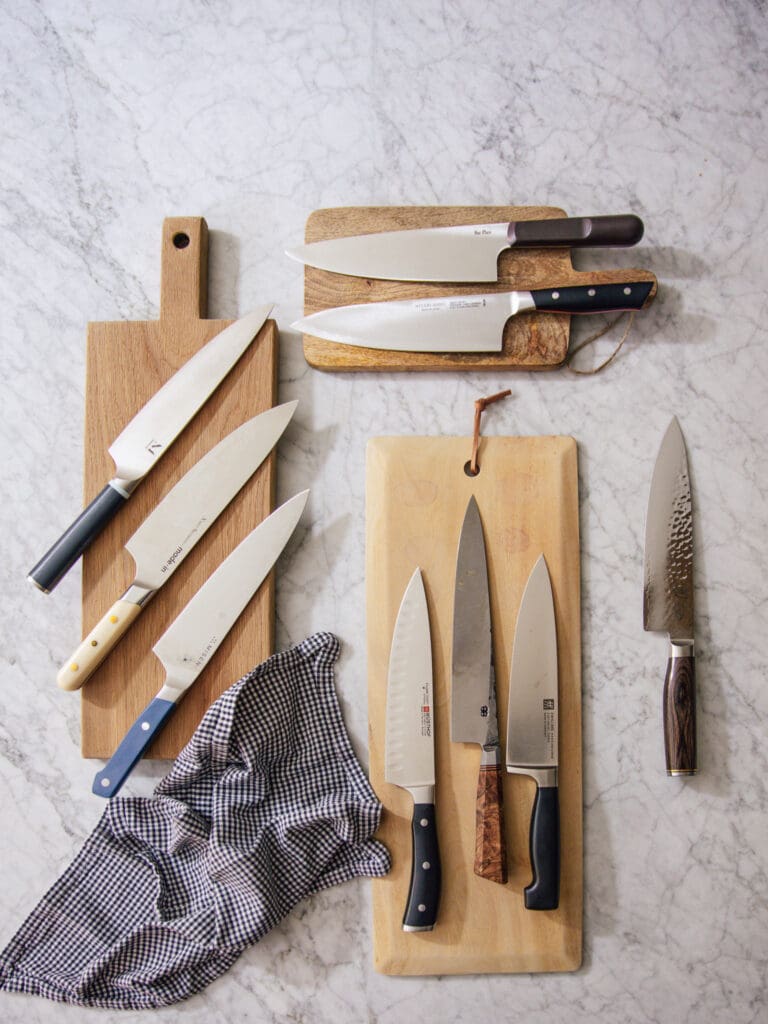
Wusthof
| Top: Epicure | Mid: Classic | Entry: Pro |
|---|
Messermeister
| Top: Royal Elite | Mid: San Moritz Elite | Entry: Park Plaza |
|---|
Zwilling J.A. Henckels
| Top: Pro Holm Oak | Mid: Pro | Entry: Twin Signature |
|---|
Japanese Steel Knife Brands

Shun
| Top: Fuji | Mid: Classic | Entry: Sora |
|---|
Miyabi
| Top: Black | Mid: Kaizen | Entry: Evolution |
|---|
Global
| Top: Classic Forged | Mid: Sai | Entry: Classic |
|---|
Standalone Knives VS. Knife Sets
I’m often asked, “Which brand of knife set is best?” But in my opinion, that question is flawed from the start because knife sets are a bad move, regardless of brand. I totally get the appeal – if you’re not sure what you want, it’s nice to just buy a package of things that someone is saying you need. But the problem is, with knife sets, they always seem to toss in a few knives you never use, but discount the price to make it feel like you’re getting a deal.
I’d rather spend $450 for three knives I’ll use every day than spend $600 for six knives that I only use 3 of anyway. You know what I’m saying? And I’m much less concerned about my knives all matching than having the knives I want. And most knife blocks included are an eye sore that just take up counter space. And, do I need to keep going?
In short, skip the pre-assembled knife set and build up a collection over time. Start with one high-quality, versatile knife (an 8in Cook’s/Chef’s Knife or Santoku) and add on slicers, paring knives, boning knives etc..

Not sure which knife to start with? If you mainly cut with up and down chopping movements, lifting the blade completely off the cutting board, go for the Santoku. If you rock chop (moving the knife back and forth, up and down without lifting the blade fully off the cutting board – shown in the picture above), choose a Cook’s/Chef’s knife.
Cook’s/Chef’s Knives
Wusthof
| Top: Classic Ikon – $179.95 | Mid: Legende – $109.95 | Entry: Pro – $26.95 |
|---|
Shun
| Top: Fuji – $399.95 | Mid: Classic – $109.95 | Entry: Sora – $79.95 |
|---|
Other
| Top: Messermeister – $199.95 | Mid: Global – $111.96 | Entry: Victorinox – $44.95 |
|---|
Santoku Knives
Wusthof
| Top: Epicure – $189.95 | Mid: Urban Farmer – $99.95 | Entry: Gourmet – $49.95 |
|---|
Shun
| Top: Fuji – $399.95 | Mid: Kanso – $114.95 | Entry: Sora – $79.95 |
|---|
Other
| Top: Miyabi – $279.95 | Mid: Zwilling – $99.95 | Entry: Victorinox – $64.95 |
|---|
Comfort & Design
With steel manufacturing becoming more advanced across all brands, the comfort and design of a knife is a bigger factor, and one that many companies have been slow to catch on to. Some of the most expensive knives out there, made with the highest standards possible in regards to their blades, have slapped on a round stick as a handle and, in my opinion, harmed the overall experience of using the knife.
I mentioned earlier that I don’t get hung up too much on brands that people choose, but this is where I’m going to make my little plug for Wusthof, because from my experience, they’re totally leading out on the comfort of their handles. Their Epicure line is, without question, the most comfortable group of knives I have ever used. They are well worth the price for someone who cooks as much as I do. But long before they sold these knives, I’ve had their Classic Ikon and Classic knives, and they’re always ahead of their comparable counterparts on comfort.
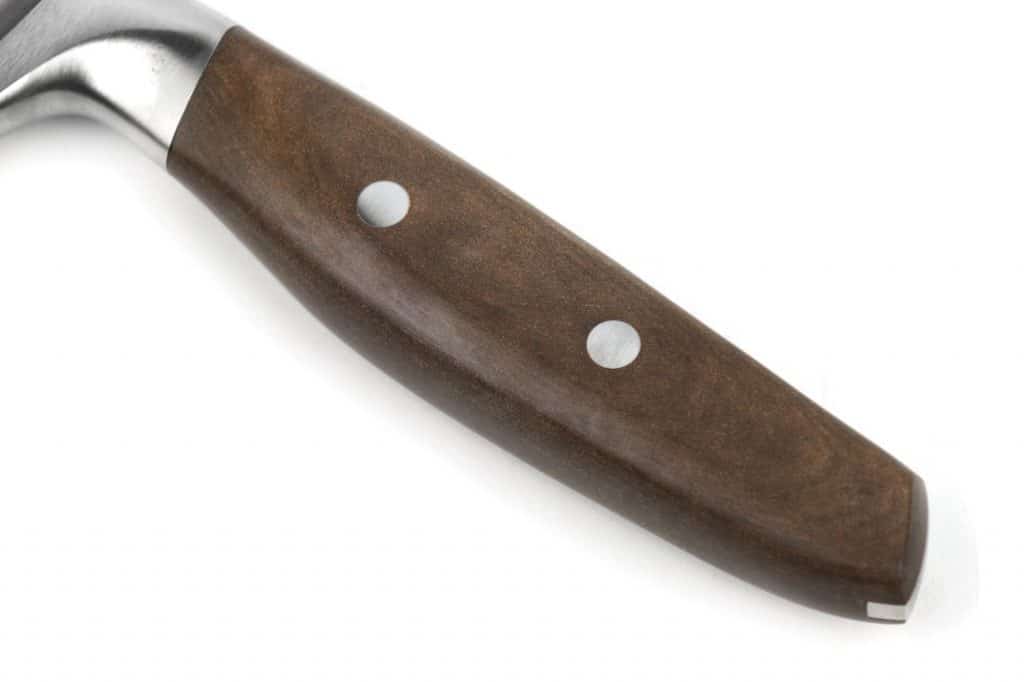
That said, there are still very comfortable knives available at a variety of price points, from a variety of brands. There’s also plenty of room to get knives that look cool as well, but be careful not to get pulled too far into that. I would still put comfort first.
Most Comfortable Knives
Wusthof
| Top: Epicure | Mid: Legende | Entry: Pro |
|---|
Shun
| Top: Hikari | Mid: Kaji | Entry: Premier |
|---|
Other
| Top: Nesmuk | Mid: Global | Entry: Victorinox |
|---|
Knife Care
Of course, regardless of price point, a knife that isn’t cared for won’t last long. Along those same lines, a knife cared for, even if it’s less expensive, can last for a decade or longer. My knife set from culinary school cost me $150. Granted, that was a deal I got through my school, but still – one of my current knives costs more than that entire set. But I used that set for almost a decade, because I was meticulous with the care I gave it. Here’s what to keep in mind:
Storage
Knives should be secured somewhere, so the blades don’t bang up against something else. Knife blocks, though sometimes ugly (IMO), do the job, but my personal preference is a magnet strip on the wall. If you must use a drawer, purchase an organizer that will keep them stable. The one we have is from IKEA and made specifically for our cabinets, but there are options on sites like Crate & Barrel or Williams-Sonoma.

| Magnetic Knife Bar | In-Drawer Organizer | Knife Block |
|---|
Cleaning
Never put a knife in the dishwasher. For real, promise me right now that you’ll wash all your knives, carefully, by hand. I don’t know the science behind it, and there are people who, since they can’t explain it, say it’s not a big deal. I don’t know if it’s the harsh detergents that eat away at the blades edge, or the intense heat, or the high powered jets, or whatever. But what I do know is, a sharp knife goes into the dishwasher, and a dull one comes out. Use soap, warm water, and your fingers (approaching from behind the blade), and take your time. Just give the knife the respect it deserves.

Sharpening
As mentioned earlier, if you have Japanese steel knives, opt for professional sharpening. Most kitchen supply stores can do that for you and it only costs a few dollars each knife (usually). If, however, you go with German steel, you can keep your knife razor sharp, all on your own.

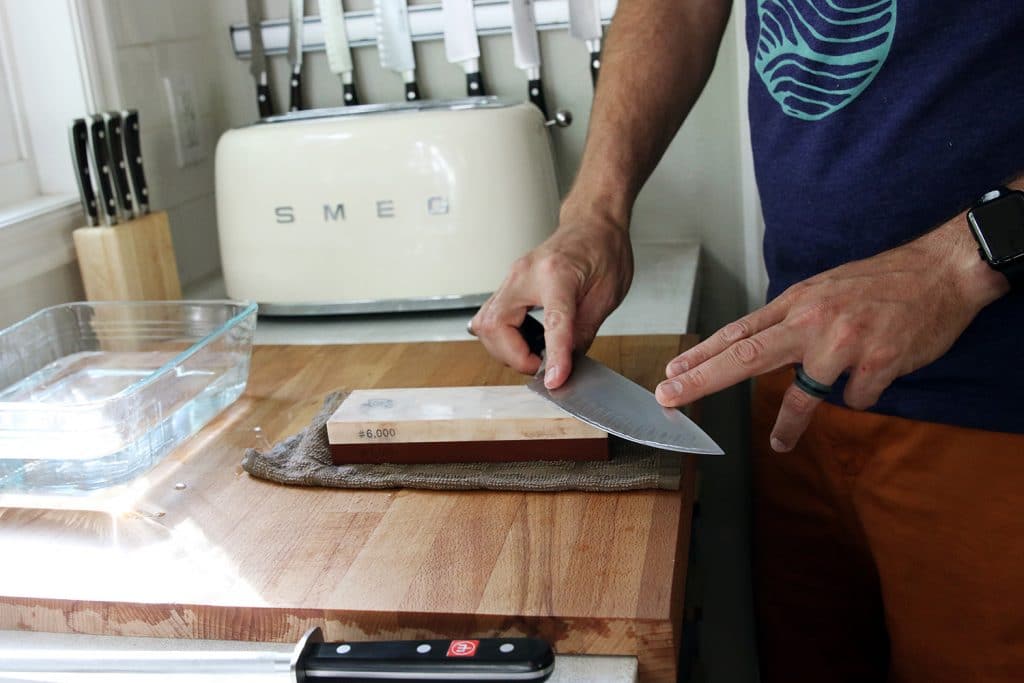
You can use the electric type sharpeners. They do a decent job, and are pretty fast. But they’re also a bit aggressive, and frequent sharpening can really do a number on the blade over time. I use a whetstone, and it’s my preferred method because I can feel what’s happening with the blade as I sharpen it.
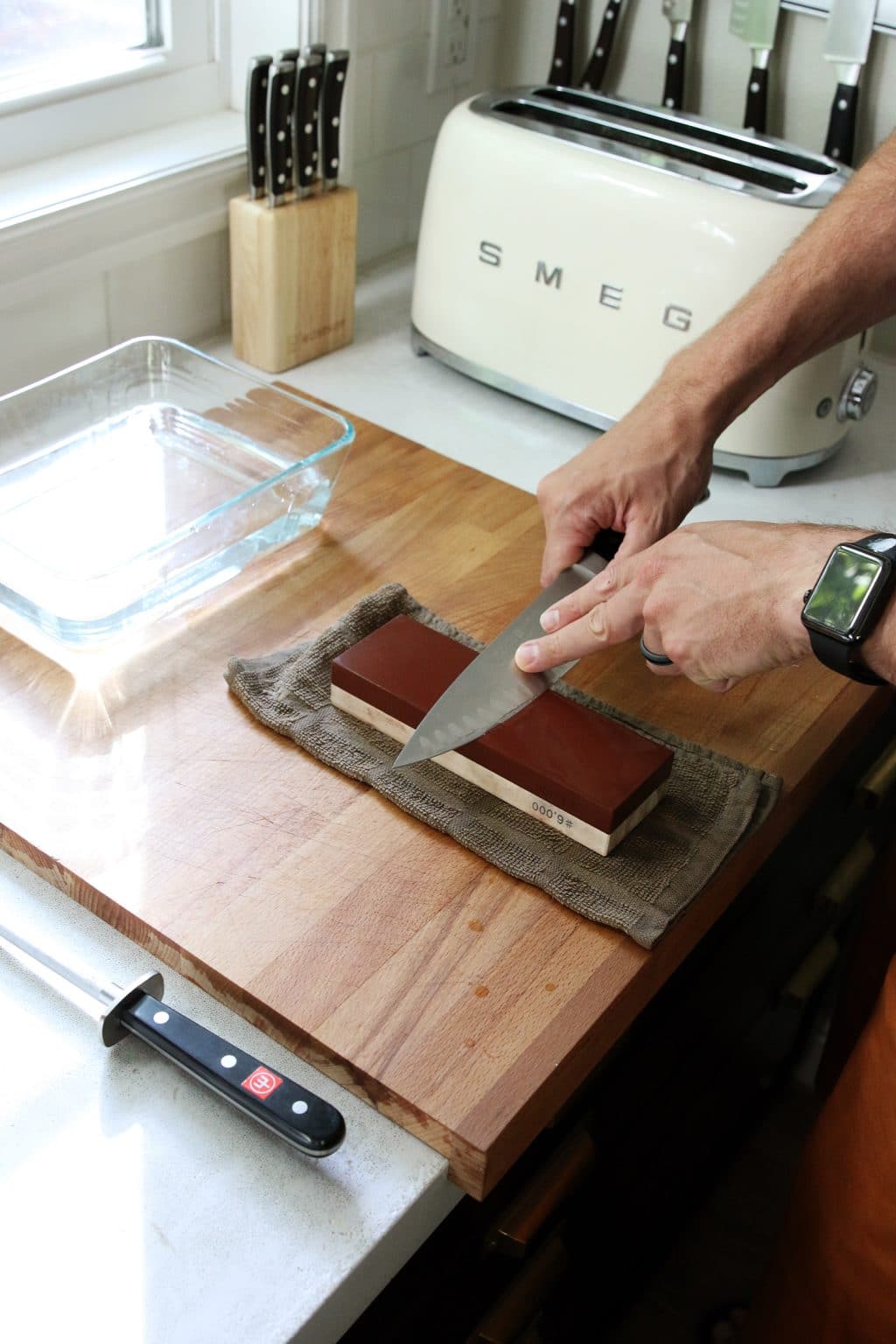
Essentially, a whetstone is compressed sand of varying grit, from rough to smooth. You begin with the rougher grit, grind off any dings or edges, then finish with the finer grit. It takes longer, but is a great way to stay in touch with your knives. I know that sounds super nerdy, but it’s true. As I sharpen my knife, I can feel bumps along the blade, and I can feel as they gradually work themselves out until the blade is straitened again. I am able to tell if my knives are taking too much abuse, and I like knowing how they’re faring. If I’m going to spend $200 on a single knife, by George I’m gonna take care of it.
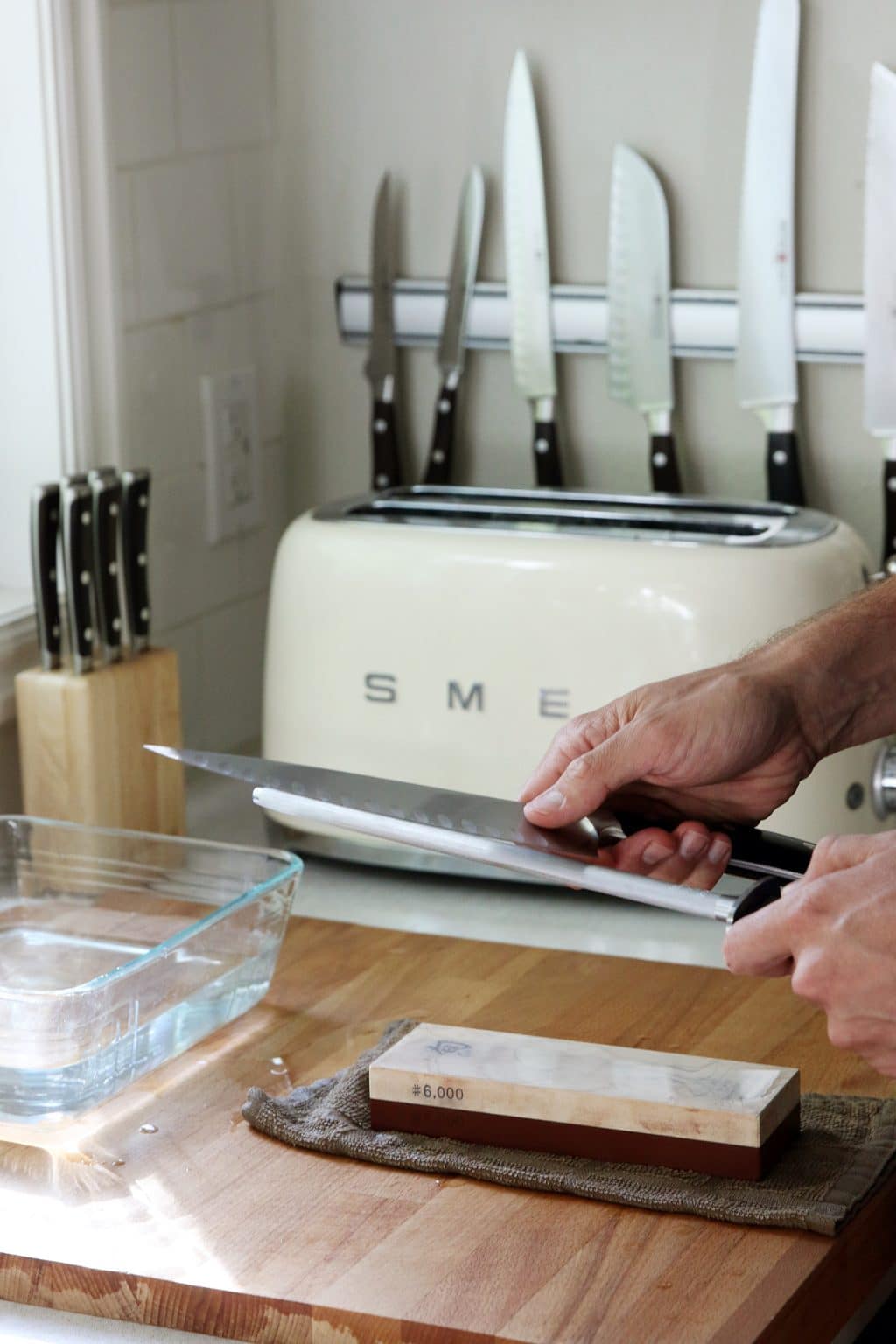
But, whichever sharpening option you go with, always make sure you have a good quality honing steel to finish off. Once a knife is sharpened, and before each time you use the knife, give it a few runs along the honing steel to straiten up the microscopic blade edge. Cross the knife over the steel, rest the blade directly on it, and pull them away from each other while running the steel along the entire blade edge.
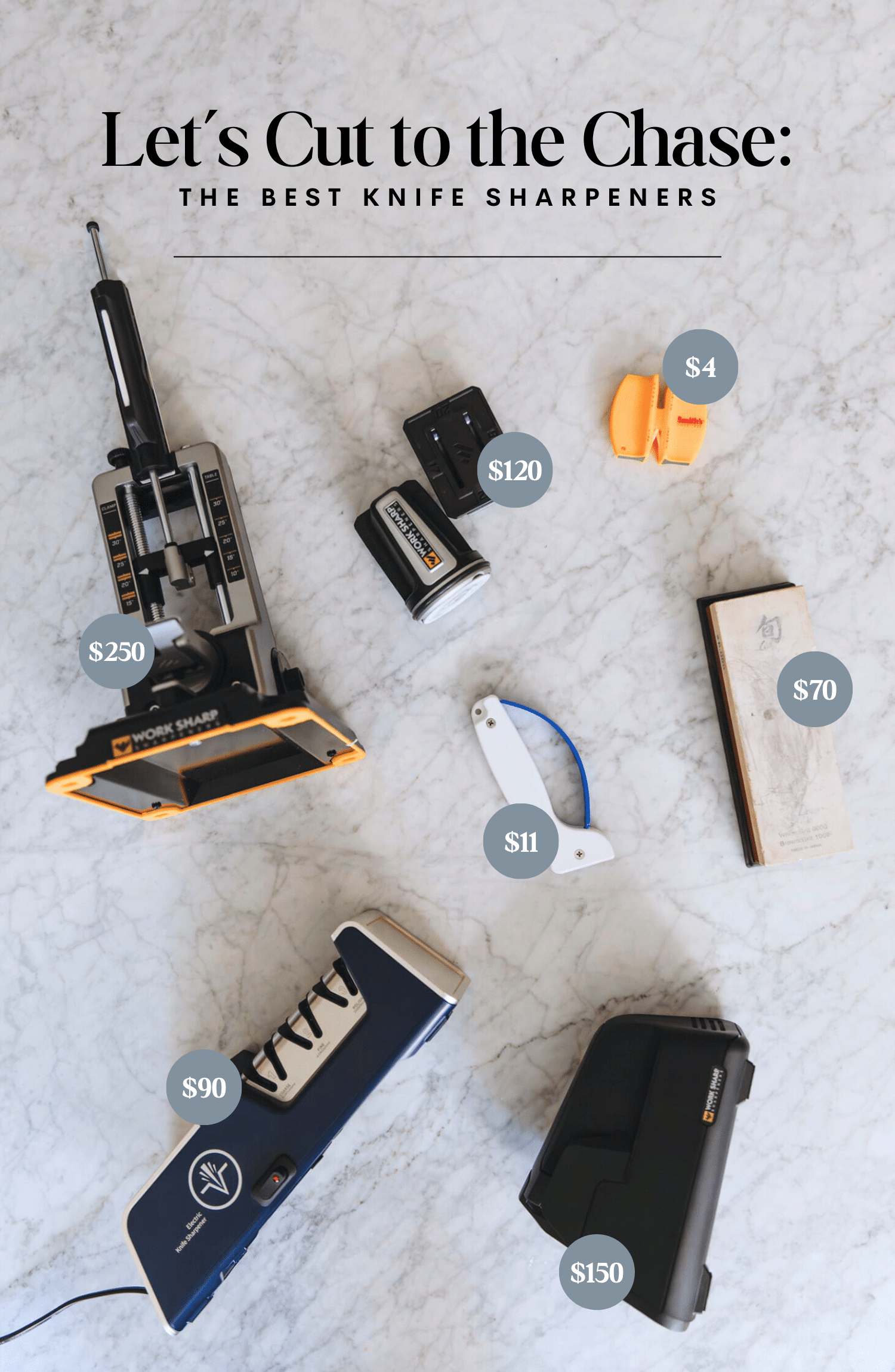
| Whetstone | Electric Sharpener | Honing Steel |
|---|
So hopefully this information is at least a little helpful to anyone trying to decide which knife they should buy, either as a first knife, or an addition to their growing collection. Really, there are so many options available, from a variety of quality brands, who all have their manufacturing process honed in (hah!). And with proper care, you can make any of these knives last for years, even decades.




This is so great! Also: Shun offers free sharpening/repair of their knives for the lifetime of the knife. We sent our 4 knives in with a chip in one, and it came back looking fantastic with no chip, and they were all super sharp! Even the serrated one, cause I have no idea how to sharpen those. We also sent in my mom’s set of 6, and hers came back beautiful as well. We both had been disappointed in the chipping/fragility of the knives, but now that we know they’ll repair and sharpen them, we’ve never been happier.
Check their website, but it’s great and super easy.
Thanks Chris! So after checking out whetstones I’ve determined there are several different grits available (by several different brands). There seem to be as many sharpening options as there are knife options! How do you know which ones are best? How do you pick a combo? I have a Wustof classics collection that I love but have never sharpened them myself and would love to learn how. Thanks for your helpful post!
I really like the Shun stones – any that they make is great!
I’m down to two santoku knives and a paring knife in my everyday life. I have the rest of the knife paraphenalia: bread, fillet, serrated this and that but find myself reaching for a santoku and paring knife most of the time. Clients-I cater-are always surprised when they see only two knives with me. But it’s a waste, as you aptly pointed out, to buy things you don’t use. It did take a while for me to figure out just how much I DON’T need. And, yes, my three knives are Wusthof. A wet stone is my favorite, easy, low tech way to keep them sharp. I grew up in Eastern Europe and my grandfather had a wheel that I manually turned and poured water on while he sharpened the household knives… more than 40 years ago.
I have the entry 8″ Victorinox Fibrox chef’s knife and use it ALL. THE. TIME. It’s the only knife I contributed to my partner’s collection of Henckels. But so, a question: when do you know it’s time to replace your knives? And, HOW do you dispose of old knives properly (aside from donating to Goodwill, etc)?
If the knife stops cutting and the blade is chipped to a point where you can’t sharpen the chips out, then it’s time to replace. But if you’re able to keep it sharp, and chip free, keep it!
Getting rid of knives – I’ve never really given it thought. I’ve always given my knives away, but they’ve been in good shape. If you’re not wanting to just toss it in the garbage, that’s definitely something to research.
I was just thinking about knives and sharpening them a few days ago! Great timing :) I would love to see a video tutorial on sharpening a knife. I’m sure they exist on YouTube but i would love to see your process!